


NEPLAN | To be done
back to overviewNEPLAN | Voltage Sags
back to overviewThe module Voltage Sag Analysis calculates the frequency of critical voltage sags (voltage dips) due to short circuits in the network. Faults are simulated at numerous points of the network, calculating the remaining (retained) voltage of all busbars. This method is known as the method of fault positions.
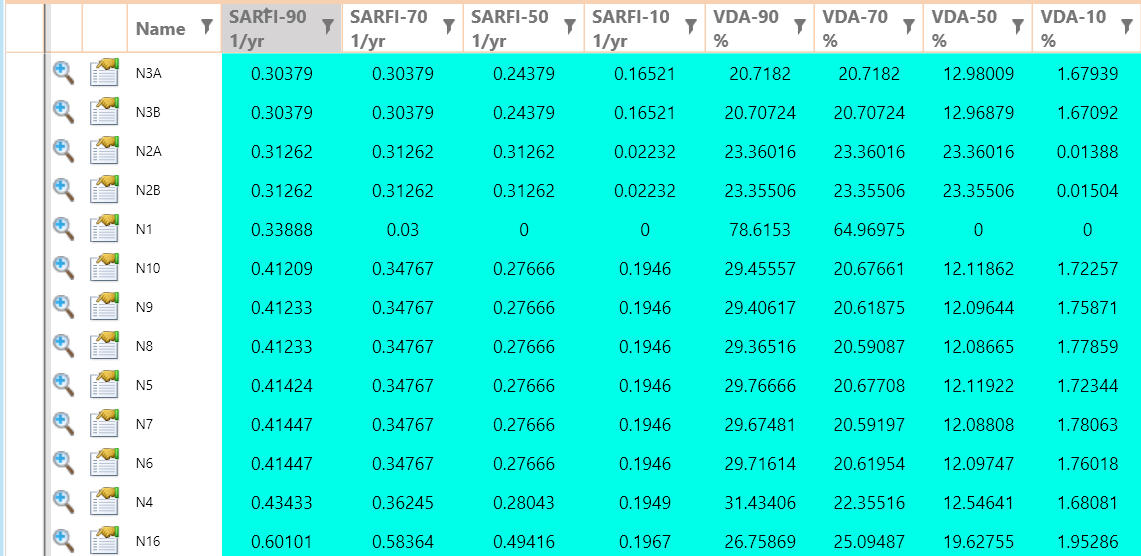
The results SARFI-90, SARFI-70, SARFI-50 and SARFI-10 are calculated for each node. The SARFI-X values are defined in the IEEE Std 1564-2014 IEEE Guide for Voltage Sag Indices. They indicate how often the voltage falls below a certain limit (X). The unit of SARFI-X is 1/yr. E.g. SARFI-50 indicates how often the voltage falls below 50% of the nominal voltage per year. For each index SARFI-X, the associated value VDA (Voltage Dip Amplitude) is also calculated. VDA is the expected value of the residual voltage during the short circuit and is given as a percentage of the nominal voltage.
Results
The results are displayed on the single line diagram and in tables:

Brochure: Introductory brochure for Voltage Sag calculation could be found here.
NEPLAN | Grid Code Compliance
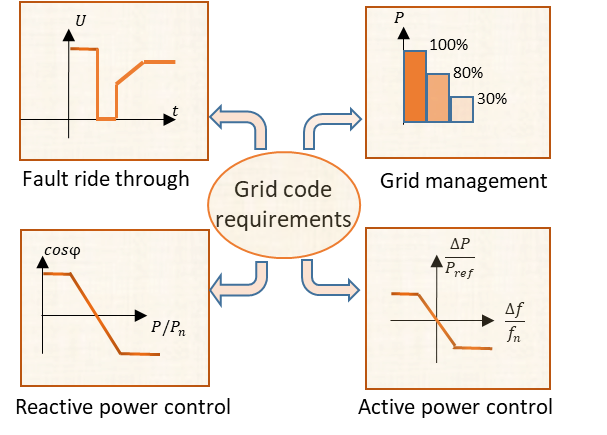
back to overviewGrid code compliance is important for the smooth connection of any kind of power generation plant to the grid. Specifically, with increasing penetration of renewable generation, the verification of grid code compliance becomes crucial for the stable and safe operation of the network. Technical requirements that need to be addressed are:
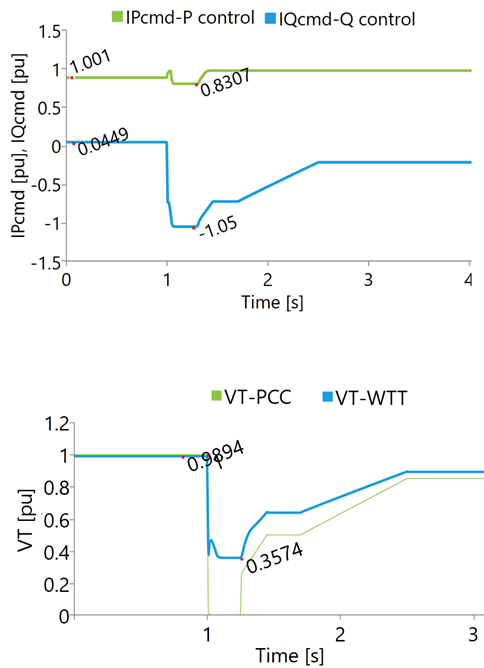
- Fault ride through (FRT) requirements
- Reactive power control
- Active power control
- Grid management
Why NEPLAN?
NEPLAN offers a solution to plant owners who need to demonstrate compliance and transmission system operators who need to assess compliance, with the modules
- Load Flow Calculation
- Short Circuit and
- Dynamic Simulator (RMS and EMT).
NEPLAN | Optimal Power Flow
back to overview
The Optimal Power Flow (OPF) function serves to determine the most efficient operating conditions for an electric power network under specified constraints. It computes optimal generator dispatch levels and bus voltage setpoints that minimize predefined objectives such as generation costs or active power transmission losses. The optimization process is subject to engineering and system limits, including AC power flow equations, generation capacity bounds, acceptable bus voltage ranges, thermal ratings of transmission lines, and inter-area power exchange constraints. In operational contexts, OPF assists system operators in maintaining reliability while economically optimizing power flow. It enables the simulation and enforcement of equipment limits, supports voltage profile adjustments, and contributes to secure dispatch decisions. The solution of all OPF problem is typically achieved via the aid of nonlinear optimization techniques, in particular primal-dual interior-point methods.
Algorithms
The Optimal Power Flow (OPF) module is designed as a highly flexible framework that adapts to a wide range of operational needs. Rather than offering rigid submodules, NEPLAN allows users to configure the OPF environment by selecting control variables, constraints, and objective functions that suit their specific goals. Functionalities such as reactive power optimization and economic dispatch are seamlessly integrated and can be customized within a unified interface. All OPF algorithms adopt AC power flow modelling.
For example, Reactive Power Optimization can be achieved by keeping active power generation fixed to predefined values, as indicated by the user or derived from scheduled dispatch plans. The OPF then adjusts reactive sources—such as generator voltage setpoints, transformer tap changers, and compensation devices—to optimize voltage profiles and maintain adequate reactive reserves across the network. Economic Dispatch Optimization on the contrary requires cost-based control of active power generation, ensuring efficient utilization of resources while respecting system constraints.
The Security-Constrained Optimal Power Flow (SC-OPF) module extends the capabilities of OPF by incorporating N-1 contingency analysis directly into the optimization process. It ensures that the computed operating point remains secure even under predefined failure scenarios, such as the outage of a transmission line, transformer or generator. This module is particularly valuable for transmission system operators seeking to enhance reliability without compromising economic efficiency.
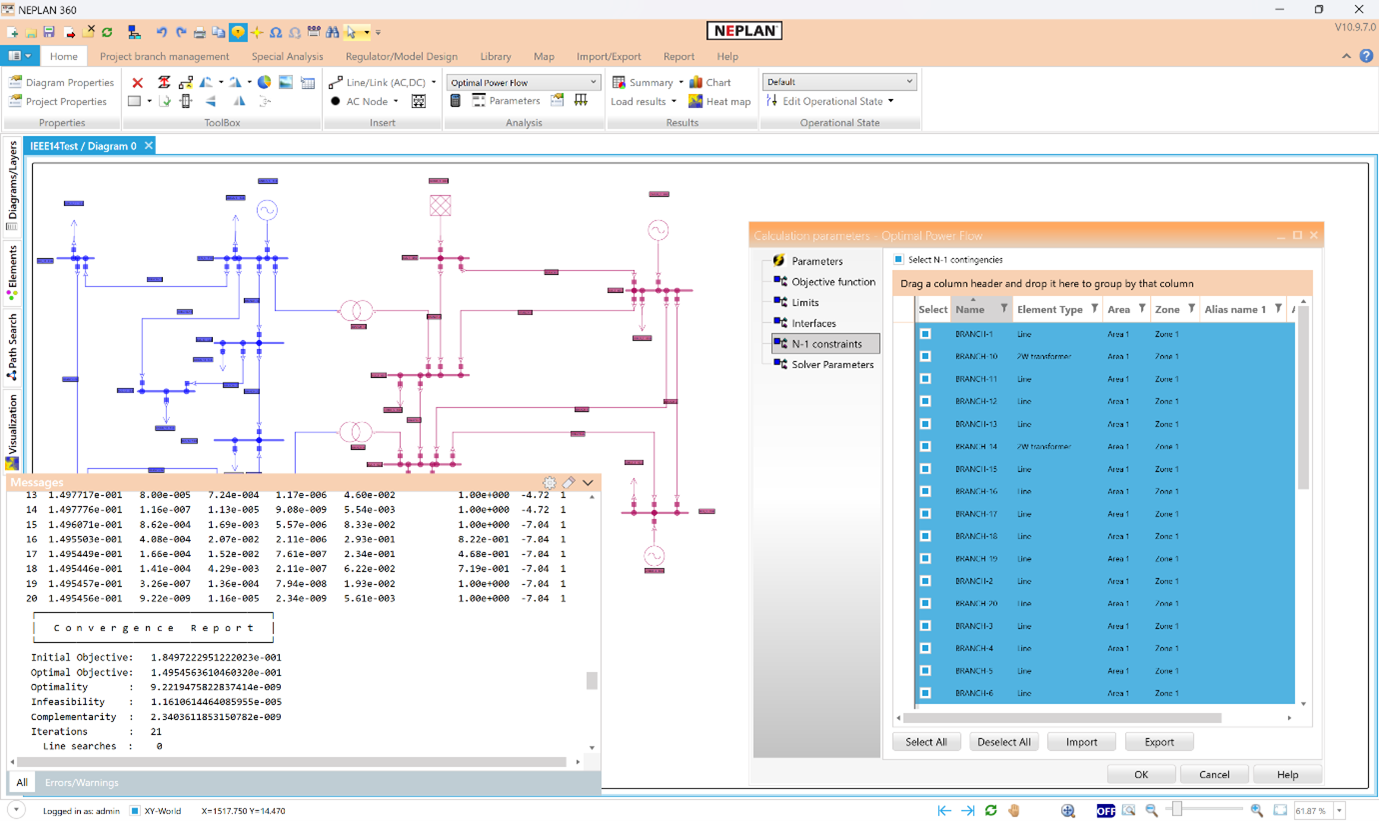
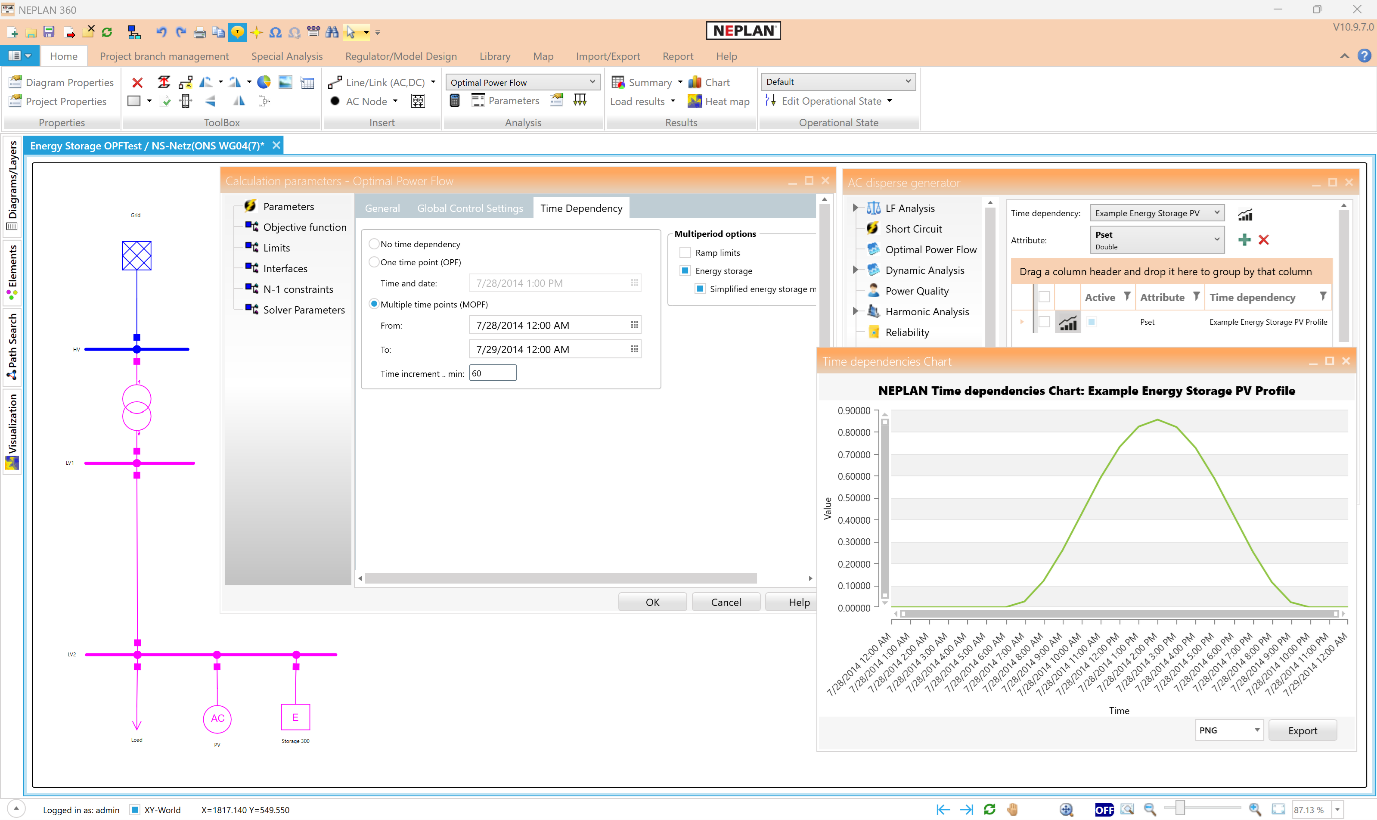
The Multiperiod Optimal Power Flow (MOPF) module in NEPLAN extends traditional OPF analysis by incorporating time-coupled constraints across multiple time intervals. This allows users to simulate and optimize network operation over a defined planning horizon—ranging from minutes to days—while accounting for dynamic system behavior. MOPF supports the modelling of energy storage systems, including battery charge/discharge cycles, state-of-charge limits, and injection/extraction efficiencies. It also integrates generation ramping constraints, enabling realistic scheduling of conventional units with limited flexibility. These features are essential for renewable integration, and system balancing under variable conditions.
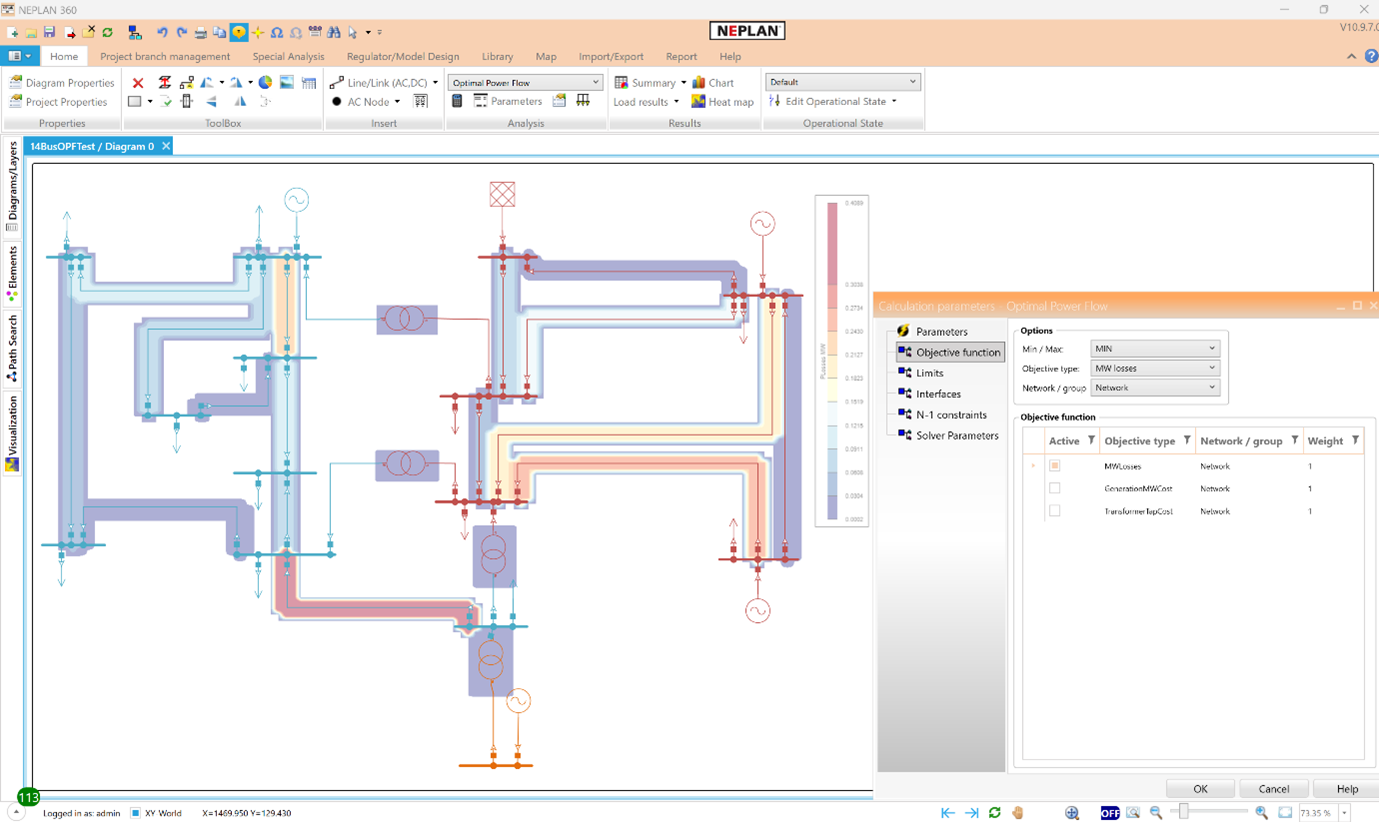
All OPF modules integrate seamlessly with the graphical interface, allowing users to visualize optimization results directly on the single-line diagram. Voltage violations, overloaded elements, and binding constraints are clearly highlighted, supporting informed and efficient decision-making.
Objectives
• Minimisation of losses
• Minimisation of costs (active/reactive)
• Minimisation of costs (shunts, transformer taps)
• Minimisation of active costs (Static Var Systems)
• Minimisation of power import
• Minimisation of boundary flows
• Minimisation of transformer flows
Control variables
• Generator active/reactive powers
• Transformer and shunt taps
• Static Var Systems
• HVDCs
Constraints
• Generator active/reactive power limits
• Branch flow limits
• Bus voltage magnitude limits
• Boundary flow limits
• Storage devices capacity limits (MOPF)
• Generator ramping (MOPF)
N-1 Contingency constraints (AC only)
• Transmission lines
• Transformers
• Generators
• Shunts
• Loads
• Static Var Systems
Results
There are several possibilities to view and analyse the results of each calculation. Similarly to load flow calculations:
• Violated elements/nodes are highlighted.
• Table results can be sorted and filtered.
• Many visualization options available (line thickness, heatmaps, charts etc.)
• Raw results can be exported in different formats.
NEPLAN | Voltage Quality
back to overviewDecreasing short circuit power, increase in consumers and generators with power electronics devices and decrease in network damping can lead to deterioration of the voltage quality in electrical networks.
Why NEPLAN?
NEPLAN helps distribution system utilities analyze and solve voltage quality problems with a variety of powerful modules:
- Flicker Analysis
- Harmonic Analysis
- Load Flow Calculation (symmetrical and unsymmetrical)
- Dynamic Analysis
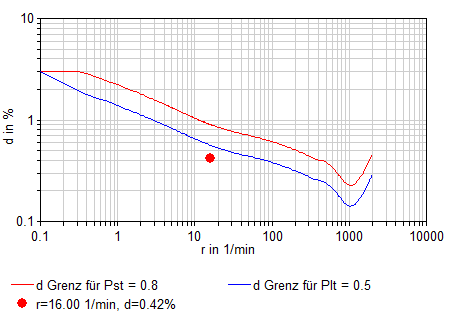
Flicker limit curves and operating point of a device
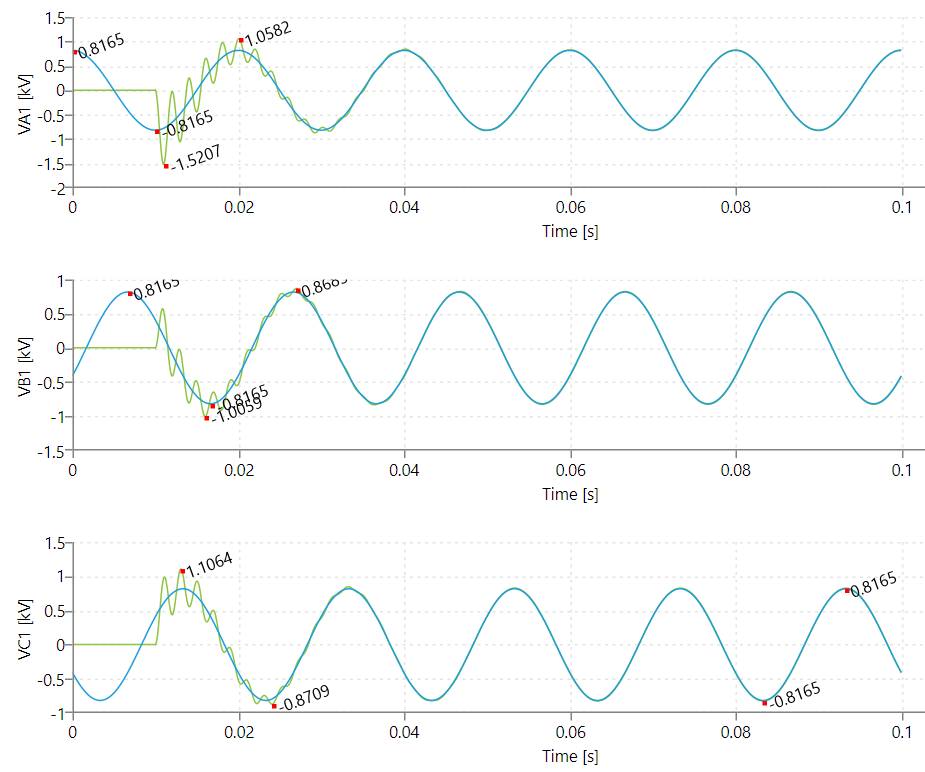
Transient overvoltage after a switching action, simulated with the Dynamic Simulation module of NEPLAN
NEPLAN | Target Grid Planning
back to overviewA target network is intended to ensure long-term high efficiency in terms of network costs and reliability. Planning is based on power forecasts for existing consumers and producers. In addition, new potential consumers such as e-mobility and decentralized generation such as photovoltaic systems must also be considered.
Why NEPLAN?
NEPLAN helps distribution grid utilities plan their target grid with its powerful algorithms:
- Load Flow
- Short Circuit
- Reliability Analysis
- Hosting Capacity
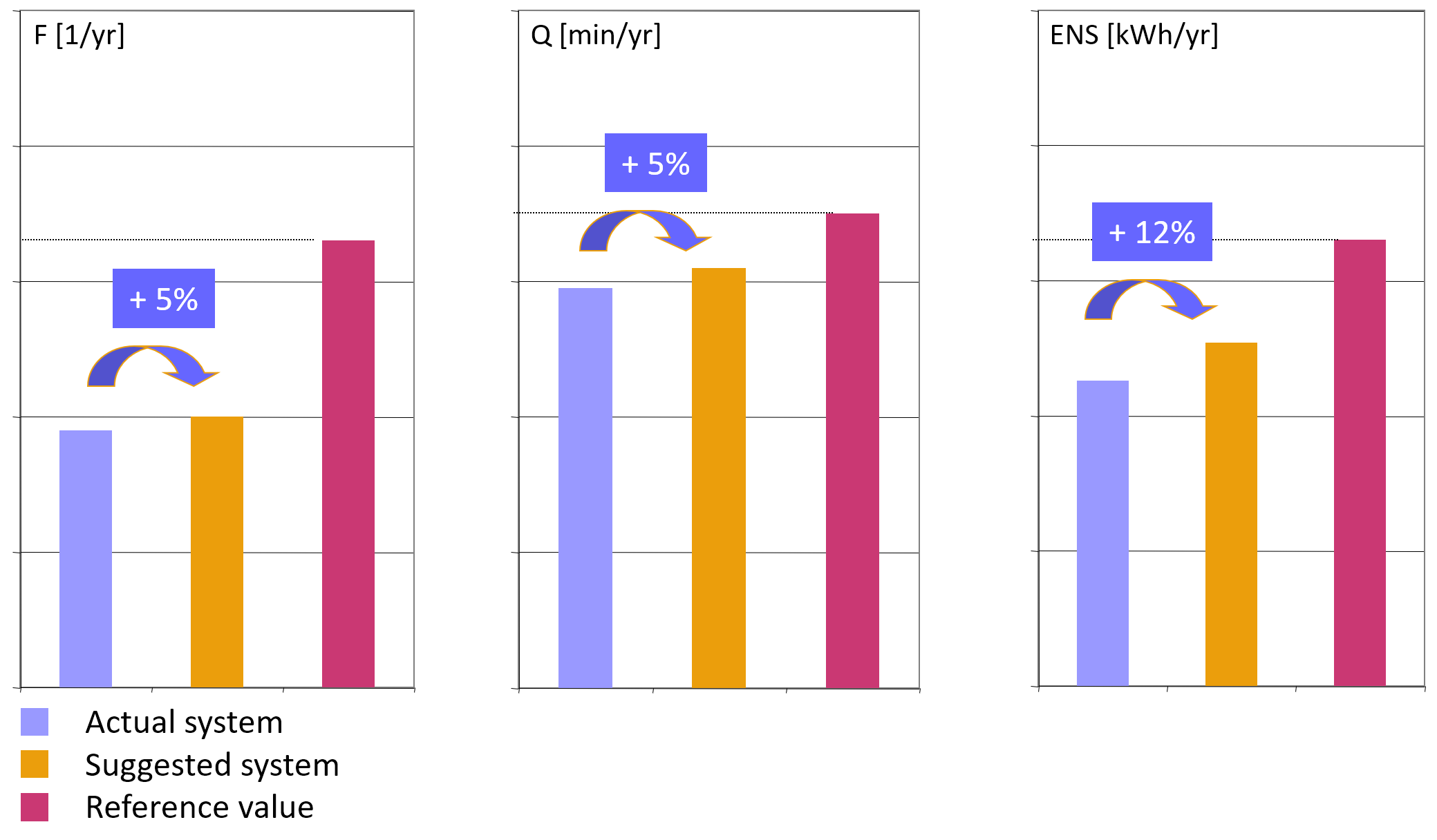
Reliability for actual and planned target system
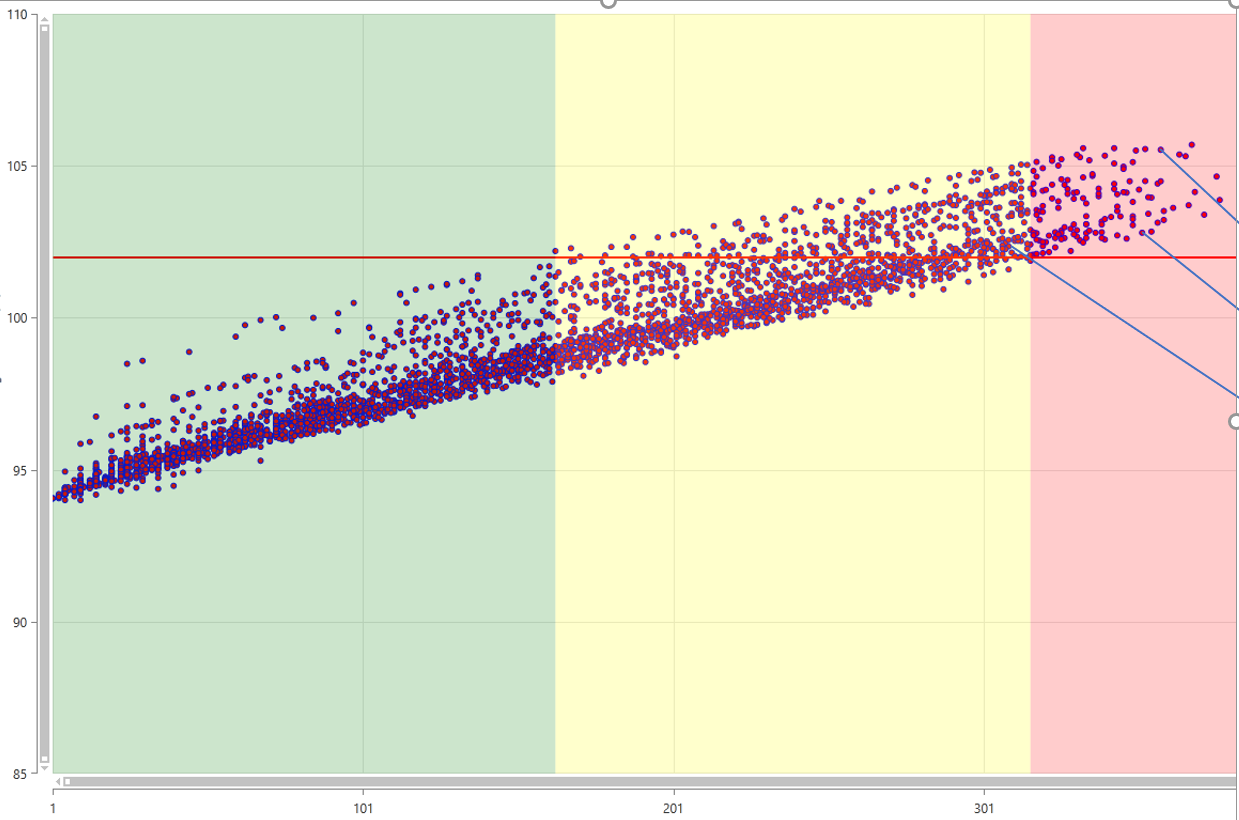
Hosting capacity of one medium voltage feeder
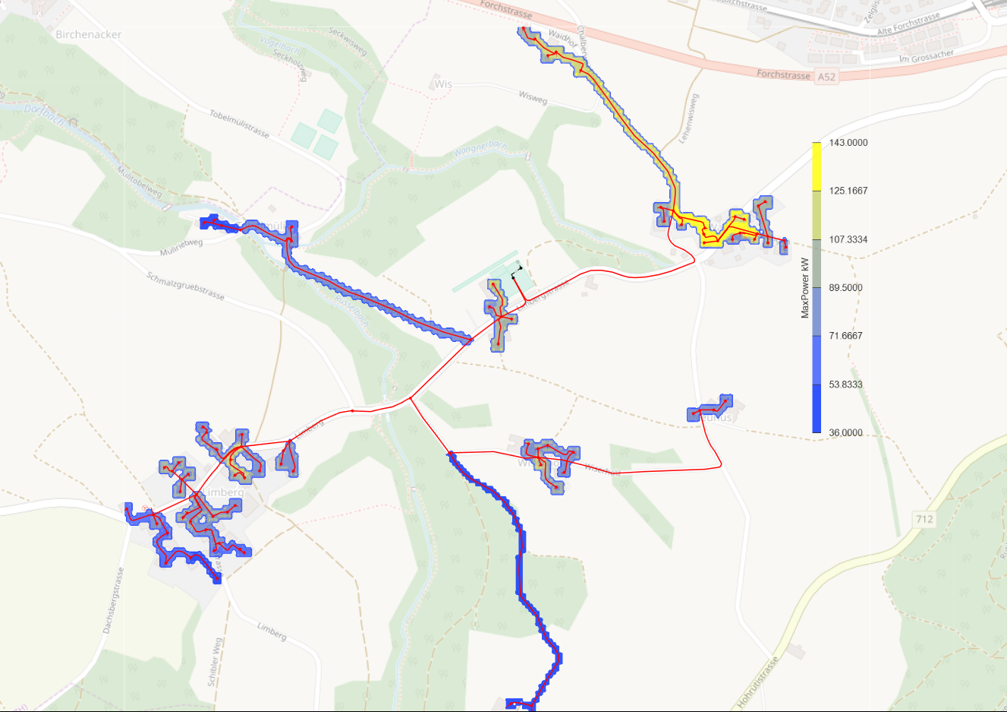
Hosting capacity an overview
NEPLAN | Protection Device Management
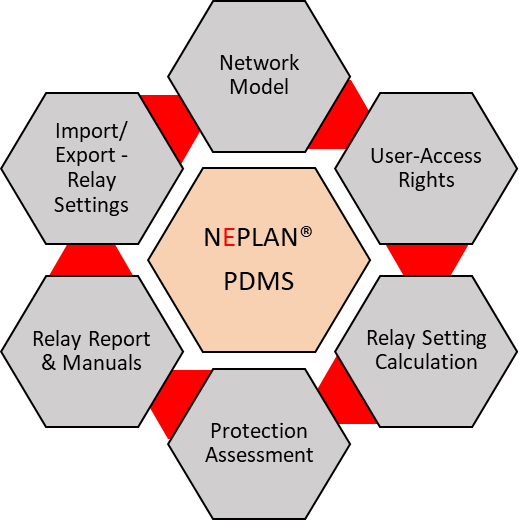
back to overviewThe challenges of utilities and industries intending to create a centralized protection database management system are among others:
- Maintaining centralized relay setting workflows
- Maintaining associated documents such as manuals and relay reports
- Excluding unauthorized access to the relay settings, etc.
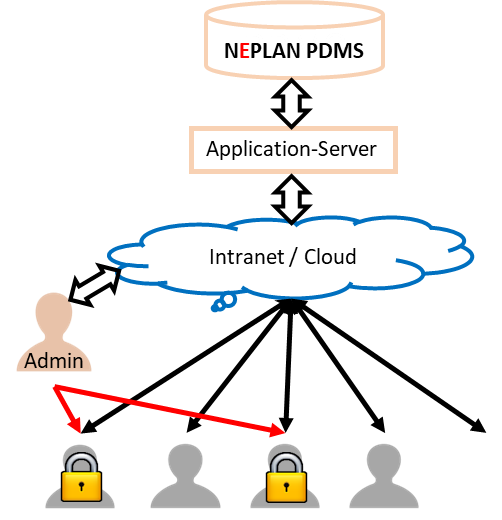
NEPLAN Protection Device Management System (PDMS) offers the solution to all of the problems that may arise from sustaining a centralized protection database.
Why NEPLAN?
NEPLAN PDMS can be used by any kind of utility or industrial customer to provide system security to the power system operations and management. It ensures correct functioning of protection devices with proper discrimination.
We achieve that by offering a multi-user database with user-access control for network model and protection devices providing direct interface to the simulation results.
NEPLAN | Protection Assessment
back to overviewReliable power system protection requires the co-ordination of protection devices for all types of fault and network loading and topology states. Operation of protection devices must ensure:
-
- Reliability, selectivity, dependability and security
- Elimination of nuisance relay tripping
- Optimal relay setting
- Inclusion of different relay co-ordination philosophies.
NEPLAN Protection Assessment helps utilities make sure that all the above aspects are respected in order to automatically assess the protection of their power system.
Why NEPLAN?
NEPLAN Protection Assessment is addressed to large transmission and distribution utilities that need to have a reliable protection system ensuring proper selectivity and sensitivity for all relay settings.
It provides automatic assessment with clear indication of relays that are not selective and faults that are not cleared.

NEPLAN | Dispersed Generation
back to overviewIntegrating dispersed generators, such as photovoltaic systems into existing electrical networks raises problems such as
- voltage rise
- harmonics and interharmonics generated by converters
- voltage fluctuation and unbalance
- increase of short circuit currents
Why NEPLAN?
NEPLAN supports distribution grid operators with the modules Connection Request, Load Flow Calculation, Short Circuit Calculation and Harmonic Analysis to master these challenges. On one hand, it enables a quick assessment based on technical rules and standards, but on the other hand, it also allows a more in-depth analysis.

Apartment house with photovoltaic system